
A SIX-PART BOOK-TO-MOVIE GUIDE • FICTION

The Odyssey Movie vs. Homer’s Book:
6 Differences That Change the Story

Christopher Nolan keeps the voyage, monsters, and return to Ithaca, but changes how the story begins, what drives Odysseus, how the gods act, and where the ending leaves him. This full-spoiler guide compares the film with Homer’s 24-book epic poem.

Find your next book 6 differences • 6 books
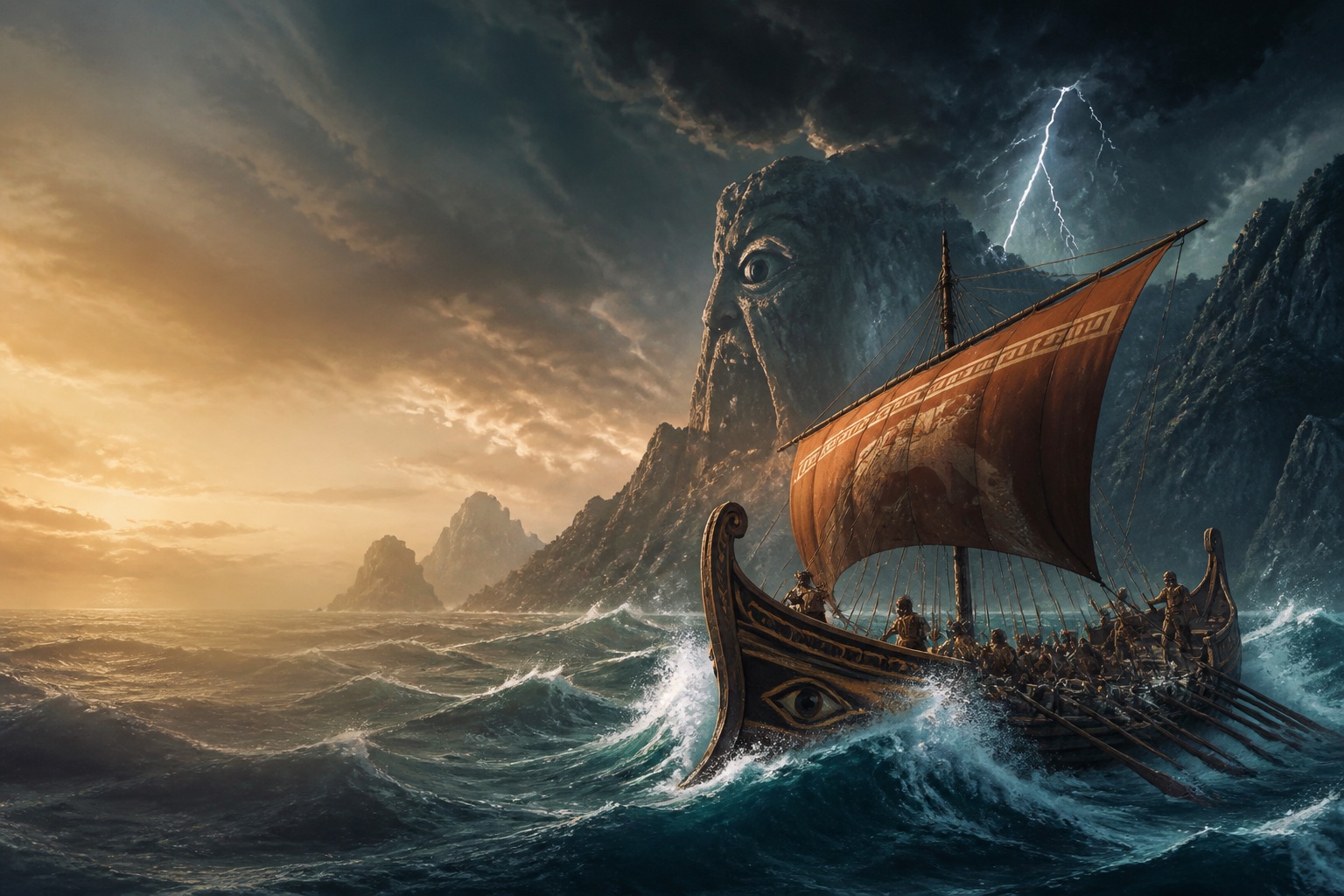
An ancient Greek ship crosses dark waves near a rocky island shaped like a watchful Cyclops.
The landmarks are familiar, but the movie changes the route—and what the journey means.

THE SHORT ANSWER • FULL SPOILERS

The movie follows Homer’s outline, not his exact telling

Both versions follow Odysseus from Troy through a dangerous voyage to a palace crowded with Penelope’s suitors. The movie, however, makes Troy and war trauma central, reduces the gods’ visible role, removes the Phaeacian frame, rewrites several famous encounters, and gives Odysseus a different final departure.

Homer’s poem is stranger, more verbal, and more interested in disguise, storytelling, hospitality, and divine pressure. Nolan’s film is more physical and psychological, turning the same broad homecoming into a reckoning with violence, guilt, and memory.

Read a classicist’s overview of the adaptation

The movie and Homer at a glance

The movieHomer’s poem
Shows Troy and the Horse as recurring traumaTroy is remembered inside a story that starts after the war
Makes Odysseus a guilt-burdened soldierMakes him a versatile trickster and teller of tales
Keeps most gods distant or unseenLets the gods debate, disguise themselves, and intervene
Compresses and rewrites the island encountersUses Odysseus’s own long account of the voyage
Changes the ambush, reunion, and Penelope’s testBuilds recognition through Athena’s plan and the marriage bed
Sends Odysseus away in self-imposed exileEnds after reunion, renewed conflict, and divine peace

YOUR READING PATH

Compare the same voyage
in six revealing turns.

This guide contains major spoilers for the entire 2026 film and Homer’s ending. It compares narrative choices rather than grading the adaptation for accuracy. Every recommended book and purchase link is reused from our existing Books Like The Odyssey Movie page; no new book link has been added.

Your reading list0 of 6 steps saved
0%
An open illustrated epic, unbranded novels, a bronze owl, red thread, shells, and an olive branch beside the sea.
Read Homer for the source, then use modern retellings to explore the voices and consequences the film brings forward.
01Structure

The film puts Troy on screen; Homer begins after it

  • Homer opens with the gods discussing Odysseus while Telemachus faces the suitors in Ithaca. Odysseus does not enter the poem’s present action until Book 5, already stranded with Calypso.
  • The wanderings are not told from the beginning in a straight line. Odysseus later narrates most of them to the hospitable Phaeacians, while the Trojan Horse appears through memories and performed stories.
  • Nolan expands the Horse and the sack of Troy into recurring action. That makes the war an immediate wound and lets the voyage feel like its consequence, not simply the long road home that follows it.
Source: Los Angeles Times on the film’s expanded Troy
Books Handpicked for You
02The hero

Homer’s trickster becomes Nolan’s traumatised soldier

  • Homer defines Odysseus through adaptability: he lies, disguises himself, tests people, invents identities, and survives by reading a room as well as by fighting.
  • The film keeps his endurance but reduces many of the verbal tricks. Its Odysseus is shaped more visibly by military command, the men he loses, and guilt over the destruction at Troy.
  • The result is a shift in emphasis. Homer repeatedly asks what kind of man can change his shape and still return as himself; the film asks whether a man formed by war can come home without carrying the war into his family.
Source: Vanity Fair on the film’s changed Odysseus
Books Handpicked for You
03The gods

The gods move from active characters to distant forces

  • Homer’s first scene is a divine council. Athena repeatedly changes appearance, guides Telemachus, disguises Odysseus, manages recognitions, and helps determine how the Ithacan conflict ends.
  • The film lets characters speak about divine power but keeps Olympus off screen. Athena appears only briefly, while Zeus and Poseidon are felt more through judgment, thunder, and the sea than through visible divine debate.
  • That changes the story’s moral weather. In the poem, mortals make choices inside a world constantly negotiated with gods; in the film, supernatural pressure can also register as nature, memory, fear, or conscience.
Source: The New Yorker on the film’s absent gods
Books Handpicked for You
04The voyage

The famous island episodes keep their shapes but change their logic

  • The film removes the Phaeacians, who hear Odysseus’s story and carry him safely to Ithaca in the poem. Calypso instead becomes the principal listener as a lotus-drugged Odysseus recovers his memories.
  • Its mostly wordless Cyclops sequence drops the Nobody ruse and the boast that allows Polyphemus to name Odysseus in his prayer to Poseidon—two moments that make language and pride decisive in Homer.
  • Circe still transforms the crew, but the film gives her anger at men a clearer motivation and changes how Odysseus resists her. Homer’s Circe becomes a lover and ally for a year after Hermes supplies the protection he needs.
Source: The Guardian’s scene-by-scene comparison
Books Handpicked for You
05Ithaca

The homecoming trades slow recognition for direct danger

  • In Homer, Antinous helps plan an ambush at sea, Telemachus evades it, and Athena carefully stages the disguised Odysseus’s reunion with his son at Eumaeus’s hut.
  • The film turns that plot into an attack at a temple. A disguised Odysseus intervenes, and Telemachus soon recognises that the stranger who saved him is his father.
  • Homer also lets Penelope control the final recognition through the secret of their immovable marriage bed. The movie removes that test, so her uncertainty and the couple’s reunion resolve through a different dramatic path.
Source: The Guardian on the changed ambush and reunion
Books Handpicked for You
06The ending

The movie gives Odysseus a new reason to leave

  • Homer continues beyond the suitors’ deaths: Odysseus proves himself to Penelope, reunites with his father Laertes, and faces the suitors’ angry relatives until Athena and Zeus impose peace.
  • The poem does contain a prophecy that Odysseus must travel inland to appease Poseidon, but it does not dramatise that later journey. Its final scene leaves the immediate Ithacan feud settled by divine authority.
  • The film omits Laertes and sends Odysseus away as a self-imposed exile, doing penance for his lost companions and the damage he caused. Home is reached, but it cannot simply erase the voyage.
Source: classicist Pantelis Michelakis on the new ending
Books Handpicked for You

BOOK-TO-MOVIE QUESTIONS, ANSWERED

The essential distinctions for deciding whether to read Homer after seeing the film—and what will feel most different when you do.

How faithful is Christopher Nolan’s The Odyssey?

It is faithful to the broad route: Troy, the dangerous voyage, Calypso, Circe, the Cyclops, Telemachus and Penelope in Ithaca, and the confrontation with the suitors. It is much freer with narrative framing, divine intervention, character motives, individual episodes, and the ending. Think recognisable adaptation, not scene-by-scene transcription.

Does Homer show the Trojan Horse the way the movie does?

No. The poem begins after Troy has fallen. The Horse and the war return through songs, memories, and accounts told by characters, while Nolan stages the Horse and the sack as major recurring action. The film therefore makes Troy feel more immediate and makes Odysseus’s victory there a source of guilt.

Is the Nobody trick in the movie?

Not in Homer’s full verbal form. In Book 9, Odysseus says his name is Nobody so Polyphemus’s neighbours misunderstand his cry for help, then ruins the protection by revealing his real name from the ship. The film turns the escape into a more physical, largely wordless sequence and drops that chain of wordplay, boasting, and curse.

Which version of Homer should I read after the movie?

Choose the Emily Wilson translation already recommended on this site if you want Homer’s full poem in brisk modern verse. Choose Barry Powell’s illustrated prose retelling if you first want a quicker way to compare the film’s plot with the traditional episodes. Both links come directly from our existing Odyssey reading list.

A THREE-SESSION COMPARISON PLAN

Read the same journey,
notice a new hero.

You do not need to reread all 24 books before comparing the adaptation. Start with the sections where the film makes its clearest choices.

  1. 01Read Books 1 and 5 to compare Homer’s opening with the film’s focus on Troy.
  2. 02Read Books 9–12 for the Cyclops, Circe, the underworld, and the dangerous route home.
  3. 03Read Books 19–24 for Penelope’s test, Laertes, the suitors’ families, and Homer’s ending.

BOOK RECOMMENDATION LIBRARY

Choose your next
reading path.

Browse by topic or search for something you want to learn, change, or understand. Each path puts a small group of useful books in a sensible reading order.

7 reading paths found
Browse every handpicked reading path.
Fiction6 steps

11 Best Books Like The Odyssey After the Movie

Gods, monsters, dangerous voyages, doomed romance, and modern Greek mythology for anyone who left the cinema wanting another adventure. This spoiler-light guide helps you choose by the part of the story you loved most.

Explore books
Fiction4 steps

Why Did Odysseus Hurt the Cyclops Polyphemus, the One-Eyed Giant?

The blinding was an escape plan; the boasting that followed was a dangerous act of pride. This concise guide separates those choices, explains the consequences, and pairs each part of the episode with a relevant book.

Explore books
Fiction6 steps

The Odyssey Movie vs. Homer’s Book: 6 Key Differences

Christopher Nolan keeps the voyage, monsters, and return to Ithaca, but changes how the story begins, what drives Odysseus, how the gods act, and where the ending leaves him. This full-spoiler guide compares the film with Homer’s 24-book epic poem.

Explore books
Language5 steps

The best books for learning a new language

Start with a learning method, then explore sound, useful vocabulary, conversation, and progress. Each step pairs a common learner question with books that can help.

Explore books
Communication5 steps

The best books for becoming a better communicator

A five-part reading path through structured thinking, concise writing, persuasion, sound reasoning, and storytelling—with a clear reason to choose every title.

Explore books
Health4 steps

Books for understanding healthy weight management

A careful reading path through metabolism, appetite, food environments, and nutrition. These books offer perspectives for understanding—not a diagnosis, prescription, or promise of weight loss.

Explore books
Lifestyle5 steps

Books for a thoughtful, French-inspired life

A reading path through gathering, everyday movement, personal style, rest, and modern French identity—chosen to add nuance to the fantasy, not sell it as a rulebook.

Explore books